Monday, September 27, 2010
Back From the Northern Wilderness
Got back into town late on Saturday night, boy does the Northcountry Blues hit hard. I had planned to fish through Saturday but it pissed rain all day and night Friday and I woke saturday morning to find the river chocolaty and gone for at least a couple of days. Rather than doddle around I thought it best to hit the road and get to those nagging responsibilities which had been building up steadily since I left the week before. After 9 dayson the road, sleeping in the tent, fishing 13 hours straight in moist, stanky waders and eating a steady diet of cornchips, PBJ and various barbequed meat I was ready to be home. Still, city life seems strange, rushed and completely detached from the reality of the planet we live on.
If you haven't heard by now they're having a great run this year up north. Tyee test fishery counts are the second highest on record and I've heard rumors of anywhere from 18,000-30,000 fish returning above Moricetown. Thats alot of steelhead and for the 8 days I was there the fishing ranged from steady to absurd. After last years trip I wanted to spend a little more time, see a some new water, and revisit some good spots from last year. I also set a few goals for the trip, 1. catch more than half my fish on the dryline, 2. catch a fish on a waker, 3. find a rhythm in my fishing. Going in I'd heard good reports and tyee counts looked good but I was hesitant to get too hopeful. The most important thing to me was to catch a few fish, on my terms, fish well, learn the rivers I fished and try my best to forge a connection with the rivers that flow through gods country.
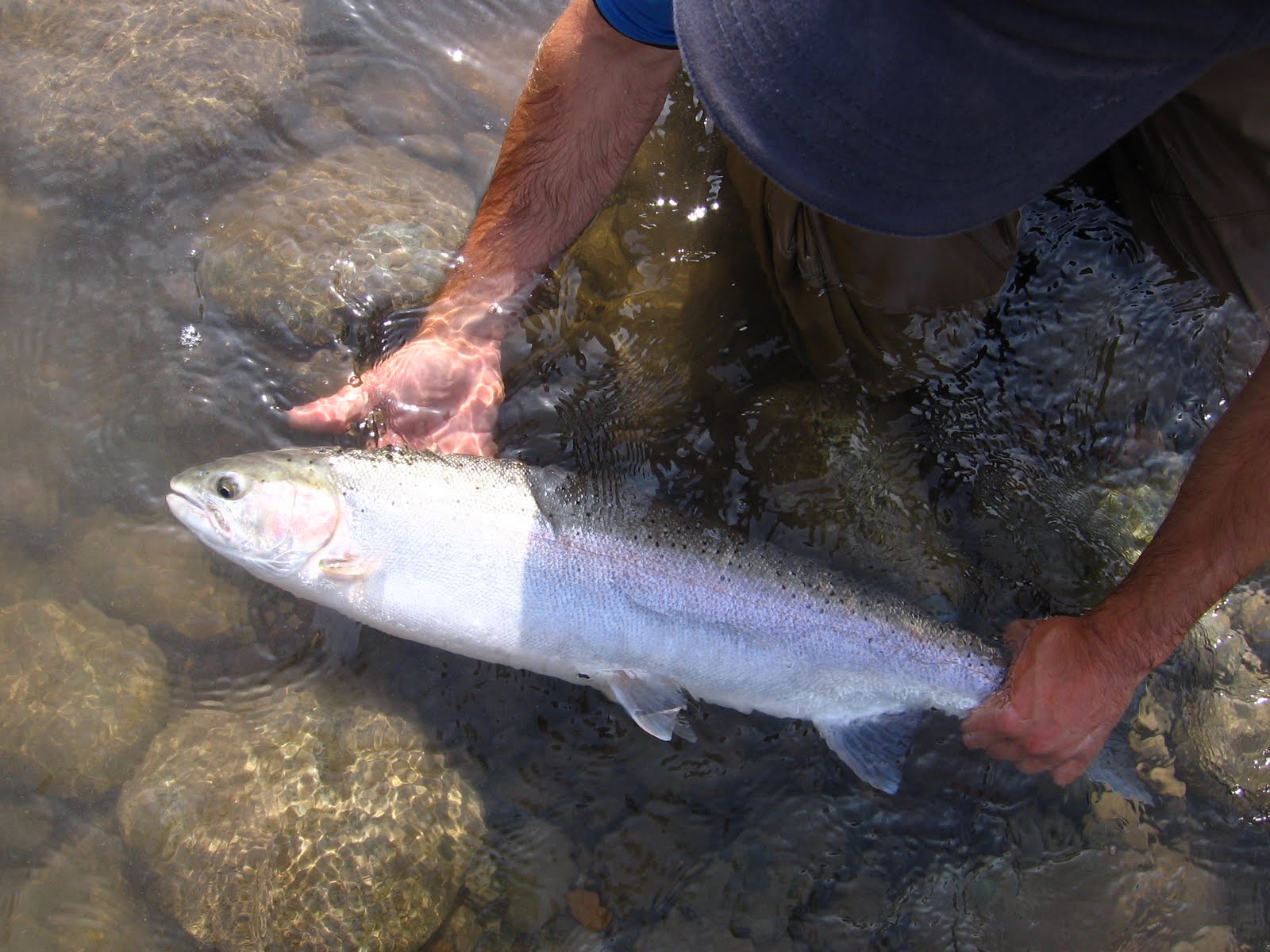
The first few days went more or less as expected. Found a small onesalt buck the first evening on the dryline with a purple smuddler which helped the confidence and reinforced the supremely fishy feeling I've had about that pattern for sometime. The next day I found a couple of fish, two which pluck plucked the first swing only to crush the fly. Also got a very large hen, probably equal in size to the two other largest fish I've ever caught (both on the big mighty river). The rest of the trip more or less as planned. All but two fish were on the dryline which was extremely gratifying. The funny thing is, despite the fact that fish in the northcountry are world renowned dryfly eaters, most dudes still fish tips. With water on the low clear side I think a dryline was actually fishier than tips and the fish seemed to have no ambivalence about rising a few feet in the water column to blow up my wakers.
The Northern Rivers are so special. I always feel like I'm looking into the past of our southern streams, into the primordial world when salmon and steelhead still outnumbered anglers when a moose or grizzly can stumble out of the woods at any minute. The north is a raw, young land. A place of epic views, harsh and abrupt seasons and rivers with a power rarely witnessed in the more southern latitudes. Even in mid september, the nights were well below freezing and each morning the tent was covered in a thin coat of ice where condensation from the previoius night had frozen. Accordingly, the fish are strong, determined and 100% wild something which is difficult to find following a century of industrial scale hatchery production. If last year was a primer to the unforgettable beauty of the northcountry and its fish this year was a big step towards total ruin. This year the timing was better, the fish more abundant and I fished on my terms, in no particular hurry and confident that the fish would willingly rise to the surface. There is absolutely nothing more gratifying or exciting than raising a steelhead to a waking fly, even if every time I have to fight my impulse to immediately raise the rod tip and take the fly away. All in all an unforgettable trip, 9 days fishing alone in some of the beautiful country on earth, I even found a few fish.
Wednesday, September 15, 2010
Heading North
Thursday, December 24, 2009
Dear BC resident anglers:
I am writing you regarding the restriction of non-resident fishing time on the Skeena River and its storied tributaries. As an angler who has spent most of my life fishing in Washington and Oregon I understand your concerns about crowding, however if you think the Skeena is crowded…try fishing the Deschutes in September. The bottom line is we live in a crowded world where wild steelhead are an increasingly scarce and precious resource and while it may seem tempting to exclude non-resident anglers from enjoying this at their leisure in the long run it could be detrimental to the fishery.
I see it like this: BC has a vast and amazing bounty of watersheds and natural resources. Frankly, it is startling to see massive declines in steelhead populations throughout much of the southern part of the province despite low population densities. The bottom line is that BC, like much of Canada, and much of the northern latitudes of the world is sparsely populated and the economy is largely driven by resource extraction, and exploitation. A perfect example is Vancouver Island, which once supported a vast and seemingly endless bounty of salmon and steelhead. Today only a few rivers on the west coast support what can reasonably be called “healthy” salmon and steelhead runs and even those are threatened by ever expanding fish farming operations. Logging and fish farming have taken a heavy toll on fisheries on the Island, and their effects are especially profound in the Georgia Strait. Rivers like the Oyster, Salmon, Nimpkish and Tsitika once were mentioned in the same breath as the Dean, Skeena, Skagit and Clearwater. Today they are nothing, supporting maybe a few hundred fish after rapacious logging, over reliance on hatcheries and massive, disastrous fish farm development have left these watersheds ravaged by man’s insatiable industrial appetite.
Today the Skeena faces many of the same threats and more. Ludicrous fisheries targeting man made sockeye runs, coal bed methane development in the sacred headwaters and the transport of highly toxic oil and solvents to and from the Tar Sands top the long list of potential impacts. Still, the Skeena has hope. The historic diversity and abundance, while reduced remains robust, and as can be expected anglers from around the world come to ply the Skeena's storied waters every year. With all these threats looming the Skeena watershed needs as many friends as she can get. To me it seems a waste of time and energy to focus on crowding when there are so many pressing conservation challenges facing the watershed. How crowded is the Skeena really?
Moricetown Falls, first nations have been fishing there since the dawn of time
Have you tried fishing the Sol Duc, Skagit, or Hoh during peak season? Have you been to the Deschutes in September or the Lower Ronde in October? You have it good my BC friends and please, please don’t forget that we let you fish at relatively little cost on our many steelhead streams. Every year I meet a number of BC residents on the Big Mighty River, or on the Peninsula. I greet them as peers, equals, part of the fabric of our steelhead culture. We’re all chasing the same things folks, a taste of what little remains of that quicksilver brilliance, the energy that can only come from the power and tenacity of a wild steelhead.
10 lbs of pissed off Big River chrome
Last fall was my first time in this amazing region of the world, and I plan to return every year of my life, god willing. Driving 13 hours to experience the awe inspiring beauty of the northcountry is well worth it, and with every swing the chance is there for a fish of a lifetime . The Skeena and her many tributaries host some of the greatest fish on the face of the earth and like all wonderful things should be shared. Anglers from all over the world annually rejoice in the grandeur of the Skeena and her fish and most of us are happy to fight on behalf of the rivers we love. I just moved to BC to start gradschool and as a legal resident of BC I can now fish the Skeena an unlimited number of days, however I can’t say at this moment in my life whether I will be a lifetime resident of BC. The odds are I wont, my family lives in Pugetropolis and that’s where my roots are. While I love my home rivers, the Skeena provides something that they cannot. Fishing for more than just crumbs, and what is truly startling is that the Skeena could be far more productive with changes in how the sockeye fishery is managed. The more people you have lobbying on their behalf, the better off the steelhead are. The current rules as they are proposed (from what I understand) would relegate Americans and other non-resident to a set number of days per year, and would favor guides massively.
Skeena Country, nice view eh?
Since I spend most of my time living under a bridge in steelhead country eating spam, and instant potatoes I am not the guide paying type, never will be. My chosen profession as a fish bum/biologist doesn’t promise to make me a whole lot of money either so the fact is I will probably never be able to afford that upper crust, guided experience. I don’t really have the desire either. As an angler who takes my steelhead fishing very seriously, I take pride in finding water and fish on my own, learning the rivers that I visit to the best of my ability, and experiencing the fishing as the locals do, without the pampering or handholding of a lodge and guide.
There are many ways to regulate crowding without cutting us out altoghether. How about limiting the number of fish anglers are permitted to hook in a given day? What about limiting the number of days consecutive non-resident anglers can fish a given river? We’re already paying our the arse to fish your beautiful northcountry rivers during prime time, why not take that revenue and start buying out sockeye boats? During my trip the most anglers I saw in a given day was 7, that pales in comparison to my day to day fishing experience in the lower 48. Still, I understand the frustration from the anglers who love fishing the Bulkley, Kispiox and Copper during peak season. The recent angling management plan is heavily biased by guides who want the Skeena as their private playground, but lets look at this as a long run problem. The crowding can be controlled through more moderate measures, those which don’t favor only guides and an elite clientele they cater to. Certainly that has to resonate with the hard working, hard fishing types of BC. The Skeena is a treasure, and she needs all the friends she can get. I know I speak for many others when I say, we’re willing to do our part. Just give us the chance.
Reel screaming northcountry henfish. share the wealth brothers
Sunday, November 22, 2009
Lazer Beams
The northcountry is something else man.Yeah, you'll work for your fish sometimes, but every last one is all chrome and all wild. Doesn't get much better than that. This sept I watched a 7-8lb fish rip 150 yards of line of 4.25" Islander in one run....and then pissed my pants